When a teen says they want to learn programming, most parents ask the same practical question: where do we start so interest does not fade after two weeks? If you are looking for python для підлітків онлайн, the real task is not simply to find lessons on a screen. It is to choose a format where a child understands what they are building, sees progress quickly, and stays motivated long enough to gain real skills.
Python is one of the strongest first programming languages for teens because it gives visible results without overwhelming them with heavy syntax. A student can write their first calculator, quiz, mini-game, or data project relatively early. That matters. Teenagers stay engaged when they can create something that feels real, not just memorize terms.
At the same time, not every online course works equally well for this age. Some programs are too academic. Others are entertaining but shallow. The best option usually sits in the middle: structured enough to build strong fundamentals, practical enough to keep a teenager interested, and flexible enough to adapt to their pace.
Why python для підлітків онлайн makes sense
For many families, online learning is not a compromise anymore. It is simply the most convenient way to access strong instruction, especially when you want a Ukrainian-speaking teacher, a predictable schedule, and lessons that fit around school, sports, and family life.
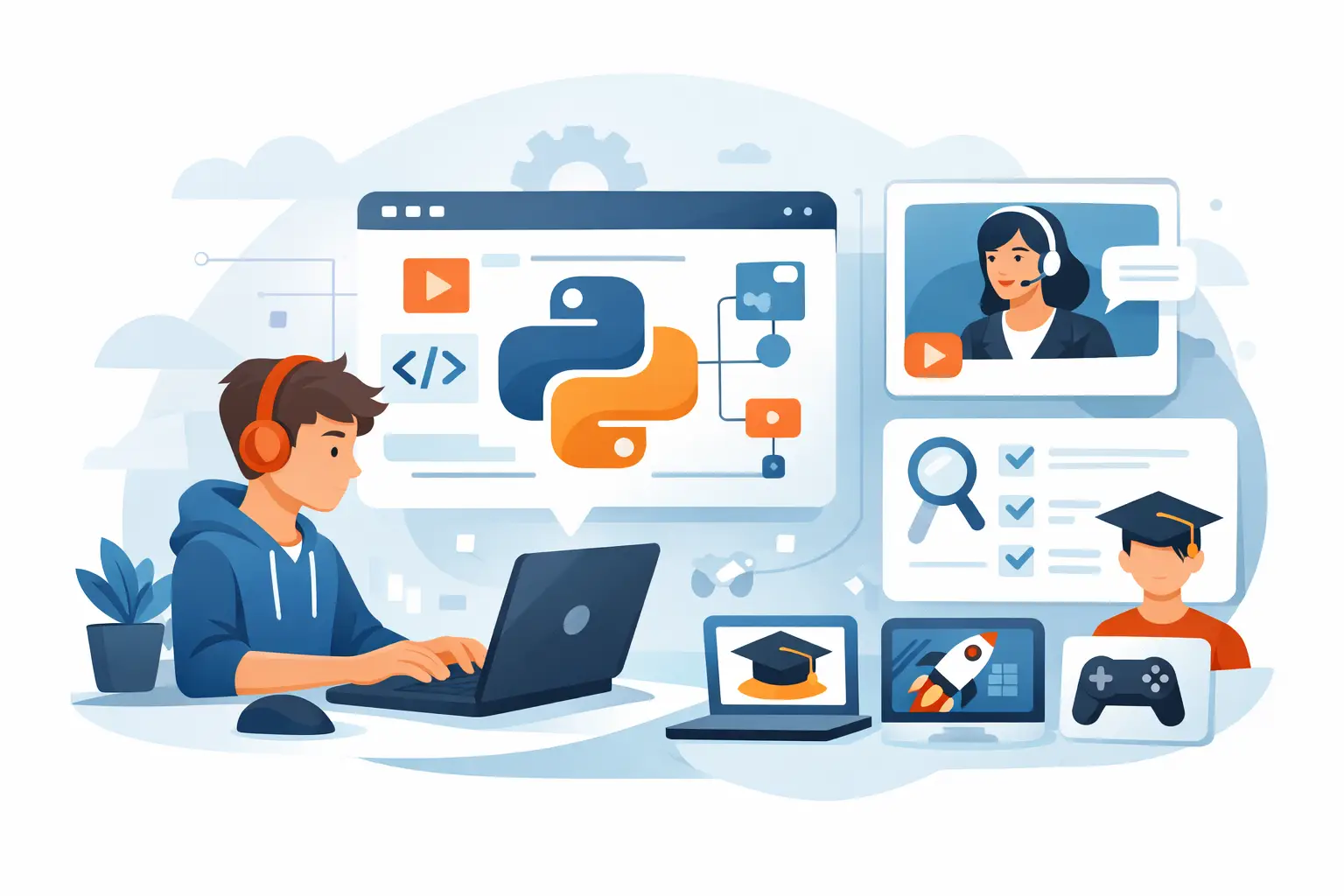
Python online works especially well because the learning itself happens on a computer. Students can write code, test it immediately, fix mistakes with a teacher, and save every project in one place. There is no gap between theory and practice. A teen sees the code, runs the code, and changes the result with their own hands.
There is another advantage parents often notice only later: productive screen time feels very different from passive screen time. A child is not just consuming content. They are solving problems, training logic, building attention, and learning how digital products actually work.
What teens can actually learn in Python
Parents sometimes hear “Python” and imagine something abstract or too advanced. In reality, a well-built beginner course starts with very understandable tasks. A teen learns how programs respond to commands, how variables work, how conditions change behavior, and how loops help automate repeated actions.
Then the course becomes more interesting. Students can create text-based games, quizzes, simple applications, logic tasks, and beginner-level automation projects. Depending on age and preparation, they may later move into game logic, data basics, or even first steps in artificial intelligence tools.
The key point is this: good Python training is not about typing random code from a lesson. It is about learning to think step by step, spot patterns, and build projects independently. These are the skills that stay useful long after the first course ends.
Who benefits most from online Python lessons
Python is a very good fit for teens who enjoy games, puzzles, technology, or creative digital projects. It also works well for students who have never programmed before but are ready for more meaningful computer use.
That said, age alone does not determine readiness. One 12-year-old may be fully prepared for Python, while another will do better starting with visual programming first. Motivation, attention span, and confidence matter just as much as age. If a course provider treats every teenager the same, that is usually a weak sign.
A strong program looks at the individual student. Does the teen like structured tasks or open-ended projects? Do they need more support at the start? Are they moving quickly and ready for more challenge? Personalization is not a bonus in programming education. It directly affects whether the child keeps going.
How to choose a Python course for teens online
The biggest mistake is choosing based only on the word “Python” in the course title. Two courses can promise the same subject and deliver very different outcomes.
Start by looking at the learning format. Group lessons can be motivating and affordable, but they often move at one common pace. That works for some students and frustrates others. One-on-one classes usually give faster and more stable progress because the teacher can explain errors immediately, adjust the lesson plan, and keep the teen actively involved the entire time.
Next, check whether the course is project-based. Teenagers learn programming better when every topic leads to something concrete. A student who builds a game mechanic, a quiz, or a useful mini-program remembers concepts more deeply than a student who only completes isolated exercises.
Teacher quality matters just as much. A strong instructor for teens is not only technically skilled. They know how to explain clearly, keep lessons energetic, and turn mistakes into part of the learning process instead of a reason to give up. For parents, this is one of the hardest things to judge from a course page alone. That is why a trial lesson is so valuable.
Finally, pay attention to structure. A good course should have a visible path from beginner concepts to more advanced tasks. If everything sounds vague, families often end up paying for lessons without understanding what progress should look like.
Signs a course will bring real results
Parents usually want more than interest. They want evidence that the child is truly learning. That is a healthy expectation.
A results-oriented Python course should show progress in several ways. First, the teen should create actual projects, not just watch explanations. Second, each lesson should build on previous material instead of repeating disconnected topics. Third, the child should become more independent over time: writing code with less prompting, fixing simple errors, and understanding why a solution works.
Certificates can be a nice addition, but they are not the main proof of quality. Real proof is when a student can open a project, explain the logic, and confidently improve it. For many families, that moment changes programming from “an interesting extra” into a serious skill with future value.
Common concerns parents have
One common concern is that programming may be too difficult. In truth, Python can be very accessible when taught correctly. Problems usually appear not because the language is impossible, but because the teaching pace is wrong or the lessons lack engagement.
Another concern is motivation. Parents worry that a teen may start enthusiastically and then lose interest. This can happen, especially if classes feel dry or repetitive. The best prevention is a personalized course with practical goals, visible progress, and a teacher who keeps the student involved rather than passive.
There is also the question of future usefulness. Is Python still worth learning? Yes, but with a nuance. Python alone does not guarantee a career, and teens do not need to think only in career terms. What it does offer is a strong foundation in logic, problem-solving, and digital creation. Those benefits matter whether a student later moves into software development, data, game creation, engineering, or another tech-related field.
Why individual online lessons often work better
Many teenagers need more than access to information. They need a learning process that responds to them personally. In one-on-one lessons, a teacher can slow down at the exact point where confusion starts or speed up when the student is ready for more.
This is especially important in coding. One small misunderstanding can block the entire next topic. In a personalized format, the issue gets resolved immediately. That saves time, protects confidence, and helps the teen experience success more often.
For international Ukrainian-speaking families, there is another benefit: consistency and comfort. Learning complex topics in a familiar language with a supportive teacher reduces stress and makes it easier for the student to ask questions freely.
That is one reason many parents choose schools like IT FUTURE, where online one-on-one lessons are built around an individual plan, practical projects, and a clear path from beginner steps to measurable results.
What to expect from a trial lesson
A trial lesson should do more than introduce the platform. It should help parents understand whether the teaching style fits the child and whether the child responds positively to the format.
During a strong trial, the teacher usually checks the student’s current level, communication style, and interests. A teen who likes games might respond well to one type of project, while another who enjoys logic tasks may prefer something more structured. This first meeting should also show whether the teacher can create a balance between discipline and encouragement.
For parents, the right question is not “Did my child understand every single thing immediately?” A better question is “Did my child stay engaged, ask questions, and want to continue?” Sustainable progress begins there.
Choosing python для підлітків онлайн is really about choosing a learning experience that turns curiosity into skill. When a teenager has the right teacher, clear structure, and projects they can proudly show, programming stops feeling distant and starts feeling achievable. The best next step is often simple: let your child try a lesson, observe the spark, and build from that point with confidence.